


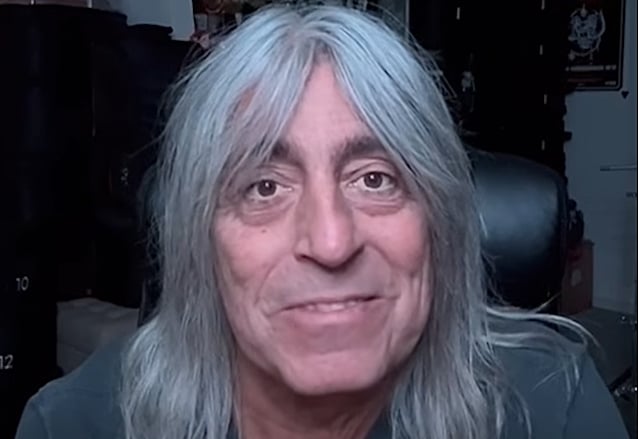
MIKKEY DEE Looks Back On MOTÖRHEAD: LEMMY, WÜRZEL And PHIL CAMPBELL, 'They're All Gone. It's F***ing Weird.'
May 24, 2026In a new interview with Meltdown of Detroit's WRIF radio station, Swedish drummer Mikkey Dee reflected on his 25-year run as a member of MOTÖRHEAD, which ended in 2015 with the death of the band's iconic frontman Ian Fraser "Lemmy" Kilmister. He said (as transcribed by BLABBERMOUTH.NET): "Yeah, it was great. We were such a team, very unique team and family, I have to say. Now all three of [the guys that were in MOTÖRHEAD when I first joined the band] are gone, Würzel [guitarist Michael Burston], [bassist/vocalist] Lemmyand [guitarist] Phil [Campbell]. It's unbelievable, when I'm thinking back how much fun we had. And then when Würzel left, I was very sad, and Lemmy [was] too. That was Lemmy's best buddy, but he just wasn't up for it anymore, so that was a big loss. But then again, we recovered and did amazing as a three-piece for most of the time there, and now they're all gone. It's fucking weird. Really weird."
After Meltdown noted that Lemmy had a reputation for sticking to his guns and not doing things that he didn't feel right about, Mikkey concurred. "Exactly," he said. "And as frustrating as that was sometimes, because he did not know everything best… We were a total democracy in this band. We voted him down many times, me and Phil. I was maybe a little bit more involved with the business as well. We all made decisions — that's not where I'm trying to get at — but I'm actually interested in numbers and the business side of it, and they were just, like, more, 'Oh, what the hell. You deal with it,' kind of. And then when it came to making decisions, of course we all sat down and did that. But because I was more involved with the business side, or more interested in it, I knew a lot more about certain things than maybe both of them together. Certain things that I really thought we had to do because it was good for us, and if Lemmy just was in that mood where he didn't wanna do it, either me and Phil had to vote him down — I mean, two against one, basically, and he didn't like that, of course — or I had to just give up because he made a point sometimes that, 'What's the point, Mikkey?' And he made me look in a different angle about it. And he was right a lot of times about this, not compromising the band or selling out. And I learned a lot from him there. We were so good together because me and Phil might be a little bit too modern sometimes for MOTÖRHEAD. And Lemmy was sometime too old-fashioned. So, he'd come with some stuff and, and me and Phil said, 'Look, we're not gonna write another Buddy Holly record,' 'cause he loved rock and roll. And he came to us and said, 'What the fuck have you guys been writing here? We're not RUSH.' 'Yeah, you're right, Lemmy. Maybe it's a little too much for MOTÖRHEAD.' So we met in the middle, and it was perfect."
Dee went on to say that Lemmy never took himself seriously as a rock legend. "He really didn't care much about this rock star thing at all," Mikkey explained. "Over all these years, and as many [musicians] as I met, he was the least rock star. And that made him so unique. I could see on his face sometimes, that he did enjoy the fact that we were gaining something maybe because of status, if you will. But he was always for the little guy. I mean, he stood up for us all the time because, obviously, a lot of times it was just, 'Oh, we want Lemmy for this TV thing or interview,' and he said, 'No, if the band isn't here, I ain't doing it.' And I remember he stood up for me when I joined the band, finally joined the band, a lot because there was a lot of hardcore MOTÖRHEAD fans, especially in U.K., they were, like, 'Who's this? Who's this guy? Is he from POISON or WARRANT or some hair band?' And they didn't know me from KING DIAMOND, obviously, and Lemmy just reamed them a new asshole, basically. 'You never seen this fucking guy play?' And later on, they accepted me immediately. He stood up for me all the time. And the first thing he said is that, 'In MOTÖRHEAD, all of us gotta be front persons. It's not me in the front; it's all of us.' So he always pushed us from behind, like, we have to step forward, we have to be front people on stage and equally on each way, and that is very, very unique — trust me — in this world, in this business because the more you can throw the drummer and the bass player offstage, the better singers and guitar players think it is. And I never accepted that. I take my space or I'm not playing with whatever band I played with. I am a front person on my drum kit."
Asked why he thinks the final lineup of MOTÖRHEAD lasted as long as it did, Mikkey said: "Well, I would've been there now if Lemmy was still alive, if we were still playing. I would never, ever quit a band like MOTÖRHEAD, because we had it all. We had the music... Oh, let's start with the friendship and the family. I'm never gonna get that ever again, I don't think, in that way. And we handpicked people — the whole crew and everyone around us were carefully handpicked over all these years. So each position of whatever people did was handpicked and perfect, fit in perfect with this band. So it was such a pleasure being on tour. And then we had the music, and we had everything. So I would never quit a band like MOTÖRHEAD."
Lemmy died on December 28, 2015 at the age of 70 shortly after learning he had been diagnosed with cancer.
Würzel died in 2011 at the age of 61 after a struggle with heart disease. Würzel was a member of MOTÖRHEAD between 1984 and 1996, and performed on seven of the group's albums including "Orgasmatron", "1916" and "March Ör Die".
Campbell died in March 2026 at the age of 64. In a statement on social media, Phil's family said he had died after a "long and courageous battle in intensive care following a complex major operation".
Campbell was a member of MOTÖRHEAD from 1984 through 2015, and for the last 20 years of the band's existence was its sole guitarist, appearing on classic releases such as "Orgasmatron", "1916" and "Bastards", among others.
MOTÖRHEAD had to cancel a number of shows in 2015 because of Lemmy's poor health, although the band did manage to complete the aforementioned European tour a couple of weeks before his death.
In June 2020, it was announced that Lemmy would get the biopic treatment. The upcoming film, "Lemmy", will be directed by Greg Olliver, who previously helmed the 2010 documentary of the same name, "Lemmy".
A custom-made urn containing Lemmy's ashes is on permanent display in a columbarium at Forest Lawn Cemetery in Hollywood, California.
Back in May 2021, Dee told the "Waste Some Time With Jason Green" video podcast that Lemmy refused to quit touring in the weeks leading up to his death, even when his health was clearly deteriorating.
"We played the last show the 11th of December [of 2015] in Berlin, and he passed just [two] weeks later," Mikkey recalled. "And that tells you, the guy died with his boots on. And both me and Phil [Campbell, MOTÖRHEAD guitarist] were trying to talk him out of starting the second part of the European tour after Christmas. But there was no way in hell we could do that. And I said to Phil, 'Look, instead of arguing with Lemmy or pushing him not to do this,' because we said maybe we should break for a couple of months for him to catch his wind, basically. I said, 'Let's not push him anyway. Let him decide what he wants to do. He knows best what he wants to do.' And he wanted to be on stage. So we said, 'Let's just support him instead,' and that's what we did. But we never made it to the second leg of that European tour, unfortunately. It was the U.K. that was on the next part of it, I remember that."
Asked if he knew when he came home to Sweden that it would probably be the end for Lemmy, Mikkey said: "No. Not at all. Because I talked to Lemmy after that show in Berlin. We were all gonna go separate ways, obviously. I was gonna just fly out to Sweden, and Phil went back home to Wales. Lemmy was flying back to L.A., but I believe he was gonna fly to London and stay one night or two or so and say hi to friends and then fly back home. And I spoke to him right after the show. I went down to Lemmy's dressing room, and I said, 'All right. Go back to L.A. and figure out, maybe, another two songs from [MOTÖRHEAD's final album] 'Bad Magic' that you think that we should do. And we take out the two songs that we already played on this leg, and we put in two new songs from the record.' And he said, 'Yeah. All right. I'll check that out.' And I said, 'Let's hook up after Christmas.' Because it was the 11th of December at that time, and I figured we'd talk between Christmas and New Year's Eve and decide which two songs that we agreed on on playing on that next leg. And he said, 'Yeah, I'll go back and work on that.' And that was it. He had no intention of not coming back to Europe and touring. So we did a little finger hook, as we always did, and that was the last time I saw him, actually. Very sad."
Dee went on to say that Lemmy had made some changes in his life to improve his health after dealing with several issues over the last few years of his life, including heart trouble. "But my personal belief is that it was maybe a little too late," he said. "He should have maybe changed a little earlier. But knowing Lemmy, he was not for that. He was doing it his way or the highway, basically. And that made him to what he was. He never compromised with his music, he never compromised with friendship, he never compromised with what way he was gonna go for anyone else in that way, which is why MOTÖRHEAD was MOTÖRHEAD, and still is MOTÖRHEAD. But with that said, of course, the three of us were talking a lot about stuff, and it was not like he was some kind of a boss here. But we all worked so good together, and that's what created the magic, I would say."


 Prev
Prev 